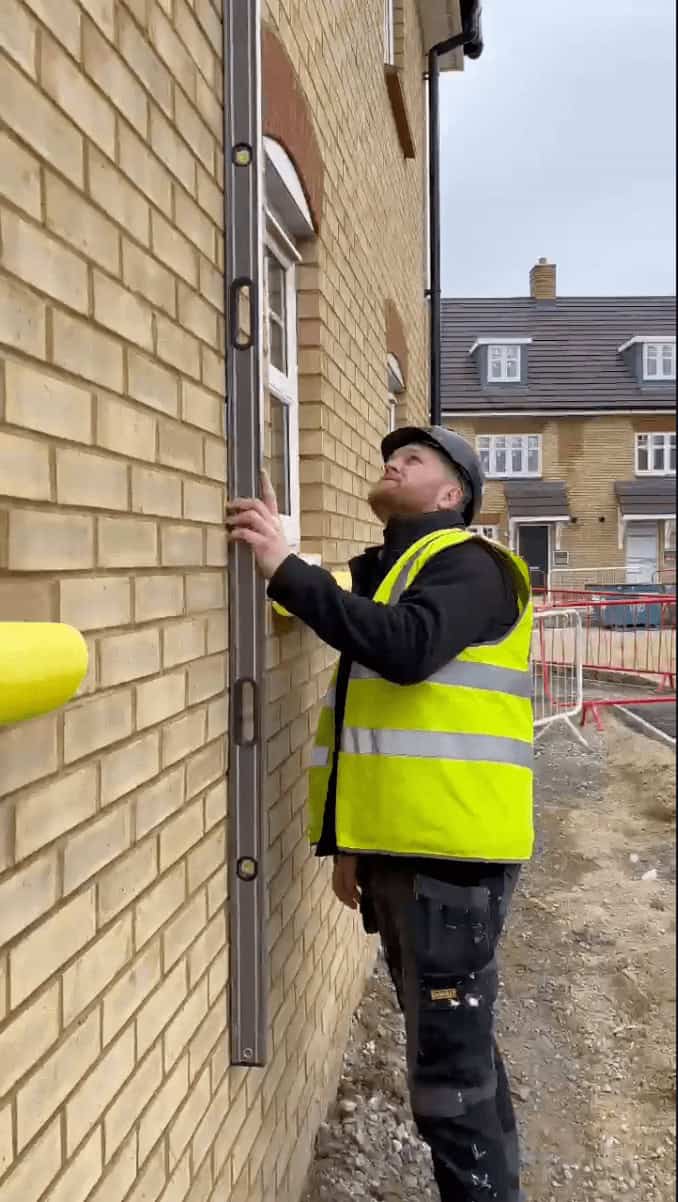
For most buyers of a newly built home, a professional snagging survey is worth considering because many construction defects aren’t obvious without knowing what to look for. However, whether you need one — and which type of inspection is appropriate — depends on when you’re buying, the type of property and what access your developer allows. This article will share our honest option
– When professional snagging is particularly worthwhile
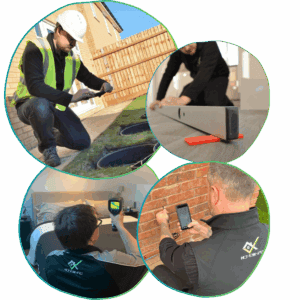
A good professional snagger will be worthwhile for most homeowners because they’ll focus on whether the most “important” aspects of construction have been done correctly. This ranges from functionality (e.g checking the heating, plumbing and drainage) to construction quality (e.g. brickwork, floor levels, loft joinery) and even safety (e.g. falls from height, scalding water, live cables). A good professional snagger will know their binders from their brick banding, and unless you are a homeowner with that sort of knowledge it is worth investing in a snagging survey from a qualified professional. The main reason is not just so you get your money’s worth from the developer – It is actually also so that you are not financially penalised in the future. One of the most overlooked aspects of getting a snagging survey done is future-proofing for when you come to sell the house… Fast forward 10 years where the house is no longer a new build and you are looking to move house, the purchasers may get a surveyor around to check the house. At this stage if they highlight significant issues that are beyond the knowledge of an average homeowner – for example a low damp proof course or missing restraint straps in the loft – it is this sort of thing that’ll concern the potential buyer who may reduce their offer or pull out of the sale altogether. This is why our company slogan is: get a Home Snag before it’s too late… There is just a 2 year warranty with the developers and then just an 8 year warranty with the warranty company directly at which point it’s very rare to get points actioned. It is worthwhile to get a professional snagger as soon as possible to hold the developer to account for the workmanship that falls below standards.
Another reason that gets overlooked is the developer may pay compensation, depending upon the severity of the issues we find in our snag list. This is particularly common when we identify issues that are invasive to fix (e.g. rebuilding walls or re-levelling joists) that the homeowner may not want to upheaval to fix… Instead they may negotiate compensation in lieu of the work being carried out which will more than cover the cost of our survey.
What snags you can reasonably check yourself
As a homeowner we appreciate a snagging survey can be an expensive proposition even though by most accounts it is cheaper than a traditional building survey. The checks listed below are very basic ones chosen that would require no tools nor any building knowledge.
- Brickwork / render: Check for damage, any gaps in mortar. Is the Damp Proof Course visible and is it 150mm above the ground level. An easy way to see if there are air bricks is the air bricks should be 75mm above ground level & the DPC will be above this.
- Garden: If the turf is freshly laid, lift it up to see if there is topsoil. Are there humps in the levels of garden.
- Roof: Gutter issues e.g. do they dip or have signs of rainwater overspilling
- Loft: Gaps in the insulation. Extractor fans connected to a vent.
- Bathrooms / WC: Run the bath taps to overflow level and take bath panel off if possible. Run showers and basins, flush the toilet to check for any leaks too. Check the tiling for cracks and gaps in sealant. Does the extractor fan work.
- All rooms: Is there any damage to the windows, (frames and glass) and do they function. Is the floor creaking and are there any humps when you walk across them. Check the radiators working. Do the ceilings appear level. Are doors closing ok.
- Kitchens: Check for damage particularly at the bottom of doors. Does the extractor fan work (the cooker hood may be a recirculating filter). Do the unit doors open and close ok and are they aligned. Are there any signs of mould.
Cosmetic vs technical defects
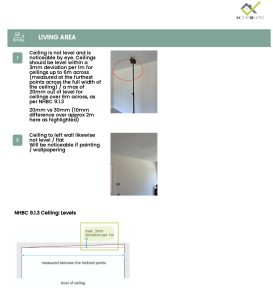 When people think of snagging they often think of minor cosmetic issues such as paintwork blemishes. Whilst we do raise examples of this in our snag list, it typically constitutes around 10% of the issues we find. Thats because our main focus is on the more fundamental aspects. And this is the key point: most homeowners don’t know what to look for. They may assume their house is fine because at face value the quality of the kitchen, bathrooms and paintwork appears good.
The technical knowledge our professional snaggers have centre around the warranty tolerances. Tolerances are essentially the rulebook set by the warranty companies such as the NHBC. It specifies how things should be done, and establishes the maximum margins of error before the developer is liable to re-do it. Examples of common issues our professional snaggers find that have associated tolerances include: walls not being plumb, turf with no topsoil, ceilings and floors not being level, restraint straps being incorrectly fitted, extraction ducts not properly connected, scratches to glazing and gaps around doors.
In our snag list, issues are presented alongside their corresponding tolerance to provide that technical aspect that is important for a site manager to take seriously. On a practical basis, homeowners often present noticeable issues to the site manager who often disregard it as being “within tolerance”, even though of course it may not be true. This is where the technical knowledge of our snaggers and presentation of issues a comprehensive snag list comes into its own as it does not get dismissed in the same way.
What a professional snagging survey costs
The average price of a snagging survey is somewhere between £450 – £550 for a 4 bedroom house. Most snagging companies charge based on the number of bedrooms to gauge how large the house will be. Some snagging companies like ours charge than one-man band snaggers due to higher outgoings such as VAT and admin personnel. Here at HomeSnag we also employ qualified surveyors which demands higher employment costs.
Importantly it is an unregulated industry, so anyone can set up a snagging company without any experience. It is therefore important not to assume a company that is cheaper will provide the same level of expertise and produce the same sort of snag list as a more expensive snagging company.
When a snagging survey may be less worthwhile
Generally speaking it is more important to hire a professional snagger to attend to do a survey on a house than it is a flat. This is not to say we do not find faults with flats – it is rather that the issues found with flats is limited to the internal aspects. Whereas with a house, a large proportion of our time spent is checking the externals where we can fundamental aspects such as the cavity walls, roof, drainage etc.
The main situation that would be less worthwhile to carry out a snagging survey if the warranty period of 2 years with the developer has expired. We offer our Fundamentals Survey specifically for homeowners that have lived in a house for more than 10 months, as it would be futile to raise cosmetic issues at this stage that would otherwise be added in a snagging survey. We rather focus in on anything of importance that the developer needs to raise before its too late (mainly with the view previously explained about potentially another surveyor noticing the issues in the future).
PCI vs post-completion snagging
 The Pre Completion Inspection is a relatively new addition to the new build industry. Implemented by the government due to the poor standards of new builds, the New Homes Quality Board established a checklist that a professional inspector should follow before homeowners move in. The idea behind this is for the homeowner to to know whether the property they are buying is of good quality. Whilst its is a welcome change for the new build industry, it is restrictive to the aspects we can check and does not go into the detail the NHBC provides in its tolerances. For example, the PCI restricts us being able to check the roof using a drone or similar device. The concept of it works for customers who are lucky to get a good quality new build, as the PCI will suffice without the need for the detail our snagging survey goes into. The problem lies when we encounter a poor quality home that desperately needs the technical input the NHBC (or other warranty company) go into.
The benefit of a Pre Completion mainly centres around us going before the homeowner collects the keys. The site team have time to action the snag list in an empty home and also it provides a 30 day deadline for them to fix the majority of issues that don’t meet standards. It can give homeowners reassurance that their home has been checked by a professional in haste of collecting the keys, which historically was never allowed until the NHQB was established.
The benefit of a snagging survey is that we are able to go into much more detail according to the warranty tolerances, which is vast. We are not restricted to tools we can use and crucially what we can or cannot raise. The main downside is that it cannot (most of the time) be done pre completion, and there is no deadline the site have to fix the snags. The process of getting the site to get trades around and arguing over snags is often a lengthy affair that many customers find draining. To assist in this, additional to our snag list we provide an spreadsheet version which allows customers and site to organise and keep track on dates, the tradesman and finally a completed column.
When to book a snagging survey
We recommend negotiating for us to attend to do our full snagging survey pre completion, around 1 week prior to completion day (but ultimately whenever the house is “customer ready”). This is the best of both worlds, but it isn’t common for the sales team or site to grant.
– Pre Completion Inspection:
Assuming they will either only allow a Pre Completion Inspection before you get the keys, it would involve arranging a suitable date with the site / sales team before booking us in. We normally attend 1 week before completion. We sometimes turn up to a house too early, so it is worth clarifying with them that the property needs to be in a state where they would be happy to move in the customer (or as near to that as possible).
– Snagging Survey
The best timescale for a snagging survey is within the first couple of weeks moving in, and ideally no later than 2 months after completion with large developers. This is not just to prevent any arguments over accidental damage they may argue was caused in the moving in process, it’s mainly relating to a survey from the Home Builders Federation that gets released around 2 months following completion. It is in their best interests to get a positive review in this survey, so the site tend to be much more attentive to fix snags during this initial 2 month period whilst the survey is in the balance. Technically speaking, any snags that our professional snaggers raise that are out tolerance should be fixed at any stage during the 2 year warranty period. However in practice, for most developers it will be an uphill battle to get snags fixed past this 2 month sweet-spot, as its no longer in their best interests.